Archive for Ryan Gosling

Drive is not what I expected

Posted in Movies, Reviews with tags , , , , , , on September 19, 2011 by Sarah

You watch the trailers, you read the reviews and you think you know what you’re getting when you walk in the theater. Not so with Nicolas Winding Refn’s Drive. Case in point, when I went to see it over the weekend, there was a group of rowdy teenagers in the back, probably 15-17 years old. I thought for sure we were going to have problems with them, that I might have to see Drive again because a bunch of kids ruined it (I’m still mad at Sasha The Crying Baby for wrecking Iron Man). Not so with Drive. The opening scene is so tight and tense that those kids shut the hell up and remained quiet throughout the rest of the movie. Whatever they though they’d be seeing when they bought tickets, Drive turned out to be something different. I know it wasn’t what I was expecting. At all.

Drive is not mandatory viewing. If I’m recommending a film for enjoyment purposes, I’d go with 50/50. Drive is a dense, tough film that gives little in the way of exposition to help viewers unwind what we’re seeing. You have to work in this film. You have to think (which is probably why it scored so low with audiences—people don’t like to think at the movies). What caught me off guard about Drive wasn’t the plot or the characters or even the staggering violence—it’s not wall to wall but when Drive gets violent it gets really VIOLENT—it was the love story.

Yes. That’s right. Drive is the best love story I’ve seen at the movies in a long time.

I know! I was totally surprised. The marketing made clear the story involved the nameless Driver (Ryan Gosling, in a crazy good performance) and his neighbor, Irene (Carey Mulligan, employing her big brown eyes to great effect). That there was some romance was a given, but that it would be so much and so beautiful was completely shocking. Irene, and her son Benecio (newcomer Kaden Leos), aren’t just the best part of the Driver’s life. They are his life. For the brief time he’s with them—even though he’s never really “with” Irene—his entire world is Irene and her son. When he loses Irene, your heart just breaks. Not because she’s gone—she was never his in the first place—but because it’s so clear that the Driver always expected things to go this badly. He never fights to keep Irene or to win her, just to save her. There’s a huge difference.

Screenwriter Hossein Amini (Killshot, The Four Feathers) deserves a lot of credit for parsing out dialogue in such a way that a little says a lot. Gosling has maybe thirty lines in the whole movie, most of which consist of “Okay” and “I don’t mind”. Amini’s screenplay is an example of barebones storytelling that gives just enough to be getting on with and wastes no time on anything more. There’s some talk that a previous draft of the script had a lot more exposition, including the Driver’s backstory, but none of it made it into the movie. I’m totally fine with that. Between Gosling’s portrayal of the character and Refn’s direction, you don’t need backstory. We can infer enough from what we are given. Information is embedded carefully; in one scene Irene’s newly-paroled husband recounts how they met, and in his brief story we gather that Irene made a dumb mistake when she was still a kid, that Irene has regrets at a young age, and that her husband, Standard (Oscar Isaac, Sucker Punch), is a creepster. It takes ninety seconds to run down a complicated family dynamic. Perfect.

Working off of Amini’s script, Gosling delivers a contained performance that is all the more frightening for its silence. The Driver never raises his voice. He barely speaks. Most of his communication comes through smiles and head nods. We might not have seen the Driver’s backstory on screen, but it’s clear that Gosling has. His characterization seethes with the unsaid. I walked away with the impression of a dog kicked one too many times. It wants to be friendly but life has taught it to expect the worst and shy from a touch, even a kind one. The Driver’s life is lonely and depressing, time split between working at a garage with a perennial loser, Shannon (Bryan Cranston, Breaking Bad), stunt driving for movies, and serving as a wheel man for criminals at night. Shannon borrows money from a gangster (Albert Brooks in what could be an Oscar-worthy turn) to set the Driver up as a NASCAR racer—at no time does the Driver appear to believe this will actually happen. Gosling’s work in this movie kicks his career up a notch and it should be ranked as one of the best performances of the year.

Still, the biggest debt goes to the director, Refn. He won the best director prize at Cannes and it’s no wonder. This is a masterful job. The opening sequence is suspenseful and so well-edited I wanted to scream (tip o’ the cap to editor Mat Newman, who previously worked with Refn on Bronson and Valhalla Rising). Refn employed a synthesizer score reminiscent of the 1980’s, neon lighting and bright gold daylight washes—I had the thought that this is what Michael Mann wanted to achieve with his Miami Vice update. The effect is both stylish and bare. Everything is a little worn down and looks worse in that bright California sunlight. The use of split screens almost made me roll my eyes but it worked within that retro ’80’s vibe. The high style of the film only underscores its emotional sparseness. For something so slick you’d expect there to be more but the only time Drive goes big is when someone is getting their head blown off with a shotgun.

Drive was a more difficult film than I was expecting. It was denser, more obtuse than I thought. It’s a violent, stylized crime noir that also happens to be a deep and satisfying, if ultimately unfulfilled, love story. It was kind of depressing, yet stripped of almost everything else, the animal will to survive becomes the “winning” moment of the movie. It’s not going to be for everyone. Even die-hard fans of The Gos might have a hard time with it. For a movie that operates with a skeleton crew for storytelling, it’s a deep, provoking story. It takes time, and probably multiple viewings, to process. You almost can’t believe what you’ve seen when it’s over. It’s unlike anything I’ve seen this year.

Let’s fight: The best actors under 40

Posted in Celebrities with tags , , , , , , , , , , , , on August 17, 2011 by Sarah

I few months ago I realized that everyone I thought of as the best actors working today are over 40. This startled me and got me to thinking about who are the top actors under 40, since they’re the ones who will take over, in a sense. I wrote out a list of nearly thirty names (over sixty when I included actresses, whom we’ll deal with next week), and started Netflixing away. Over the next couple of months, I began winnowing down my list. For example, I realized that while I like Shia LaBeouf and think he’s talented, he tends to make crap movies. The last few years have shown a dearth of good taste, a kind of lowest-common-denominator thinking that concerns me. Sure, Shia will deliver quality to your crappy blockbuster, but the result for him, as an actor, is a kind of stagnation I can’t admire. So he was removed from the list.

There are other criteria at play—I tried to be scientific about this. This isn’t just a taste call (although certainly my taste can’t be divorced entirely from it); I tried to use a set of objective standards in my judging process. My basic criteria are three things: body of work, diversity of work and recognition received. I was looking for, essentially, consistency—actors who deliver at the highest level again and again. Take Ben Foster. My taste dictates that he’s an amazing talent and should be on the list, but the formula I derived said otherwise (he’s made one too many bad movies). So I had to remove him in the name of objectivity.

You might be asking, Why did you only consider actors aged 25-39? I could never do this kind of thing for actors under 25 for the simple reason that they’re still unformed at that age. Still finding their feet. You don’t know how that’s going to translate into a mature career. What’s precocious at 17 might not work at 27. By 25, though, they’ve had time to amass a significant body of work, to diversify, to explore other media. Certainly we can point to certain people and say that they’re very talented and are bright prospects. But there’s a reason a lot of child actors fail to transition into adult careers. You have to be capable of making that leap in the first place.

Yesterday I asked the Twitter who were the best actors under 40. I wanted to input popular opinion into the final equation, though I’m sure we’ll be fighting over this anyway. When I got down to 20 actors I had to start making some tough calls and while Jake Gyllenhaal, Diego Luna, Anthony Mackie, James McAvoy and Elijah Wood didn’t make the final cut they were really close and deserve some recognition anyway. And now, on to the best actors.

Christian Bale

Where you’ve seen him: Christopher Nolan’s Batman movies, American Psycho

Don’t miss him in: Velvet Goldmine

Where do you even start with Christian Bale? Do you know how hard it was to pick just ONE movie everyone should see him in? It’s debatable, because we all have different taste, but to me, Bale is the single best actor working under 40 today. To me great acting is the ability to convince me of anything and Bale can convince me of anything. It’s so cliché to say an actor is “chameleonic”, but that’s exactly what Bale is. He inhabits each character completely, often transforming his body to do so, but the real mark of Bale’s talent is his ability to crush everyone around him (I call this being a “screen tyrant”). Check him out in The Fighter, obliterating Mark Wahlberg in every scene. When Bale is on screen, you can’t look away. The only actor who’s come close to stealing his spotlight is Heath Ledger. The only other actor I can think of with that same tyrannical bent is Daniel Day-Lewis. Yeah, I said it. Christian Bale = Daniel Day-Lewis.

Benedict Cumberbatch

Where you’ve seen him: Sherlock, Atonement

Don’t miss him in: Hawking

I crush on talented guys. To me, being good at something is sexy. I don’t care if you’re a plumber, an athlete, or a lawyer—if you’re good at what you do you gain a unique confidence that is like crack to me. It’s not about being arrogant, it’s just being assured that you’re doing exactly the right thing for you and you’re doing it well. That’s Benedict Cumberbatch all over. Cumberbatch is just beginning to make his mark across the pond, but in the UK he’s widely regarded as one of their brightest talents. I’d have to agree. Film, television, theater—Cumberbatch lights it up wherever he goes. He even does radio! There is nothing he can’t do and he makes it all look so ridiculously easy. He’s getting the best work in film, television and theater so it’s only a matter of time before everyone stops making fun of his name (myself included) and starts taking him seriously.

Paul Dano

Where you’ve seen him: There Will Be Blood, Little Miss Sunshine

Don’t miss him in: Meek’s Cutoff

While everyone was watching Daniel Day-Lewis destroy the scenery in There Will Be Blood, Paul Dano quietly delivered one of the most impressive performances in the first decade of the 2000s. When I connected him to the morose, near-silent teenage son in Little Miss Sunshine, I was shocked. Same guy! But totally different! Dano is impossible to get a read on—you can’t extrapolate his real personality from his performances like you can with some actors. He’s an intensely focused performer who is a weird mix of choosy and accessible. He works in some of the most out-of-the-way movies being made yet pops up with small parts in stuff like Knight & Day and Cowboys and Aliens. Dano ducks the limelight, too, so his career will likely continue as a slow burn for years to come, but one day I promise we’ll all look around go, “You know that Paul Dano? He’s like, our best actor.”

Leonardo DiCaprio

Where you’ve seen him: Inception, The Aviator

Don’t miss him in: What’s Eating Gilbert Grape

Has anyone transitioned from child actor to Serious Adult Actor better than Leonardo DiCaprio? Here’s how good an actor DiCaprio is: Going into The Departed I told myself, “Don’t get attached to anyone—everyone is going to die.” As the movie unfolded I kept chanting to myself, “Don’t care, don’t care, don’t care,” and still I got my hopes up. I was rooting for DiCaprio’s character, Costigan. I even started to think he was going to make it out okay. Leonardo DiCaprio, the man who’s made a career out of dying on screen, managed to convince me that he wasn’t going to die in a Martin Scorsese movie—the director who’s made a career out of killing characters. He made me care AGAINST MY WILL. Once a teen heartthrob, DiCaprio has had to fight to get taken seriously and short of Johnny Depp, I don’t think anyone has done a better job of making that leap.

Jesse Eisenberg

Where you’ve seen him: The Social Network, Adventureland

Don’t miss him in: Rodger Dodger

Of course Jesse Eisenberg would be on here, because he always makes the list. Eisenberg is the geek chic choice of the week for a lot of people, but to assign him only nerd status is to ignore that he’s got a face made for cold calculation. What made him so impressive in The Social Network wasn’t that he was believable as a socially awkward computer genius, but that he was believable as a stone-cold ruthless businessman. He’s an odd combination of vulnerable and unpredictable on screen. Eisenberg balances film work with off-Broadway plays and he sometimes writes (he has a play in development off-Broadway), and he’s a bit reclusive, which keeps him intriguing. Some people build careers on their face or their abs, others on an ability to tell a good joke. Eisenberg is building his on mystery.

Chiwetel Ejiofor

Where you’ve seen him: Children of Men, Love Actually

Don’t miss him in: Kinky Boots

The man with the most impossible name to pronounce, Chiwetel Ejiofor, is also the most under-served actor on this list. Like Cumberbatch, Ejiofor is a popular guy in the UK, but stateside he’s best known for supporting roles in stuff like American Gangster, 2012 and Salt. I first noticed Ejiofor in 2005’s Serenity, in which he played the unflappable Operative. It’s a chilling example how sometimes the scariest bad guys are the ones who never raise their voices. And his performance as Othello in London’s West End was equally chilling, though for different reasons, even in blurry bootleg form (he won an Olivier Award for it). Ejiofor has the ability to electrify at will—if he wants you to feel it, you’re going to feel it. But it was the dominance he displayed in Othello that really won my admiration. He’s got some Laurence Olivier voodoo working for him.

Michael Fassbender

Where you’ve seen him: X-Men: First Class, Inglorious Basterds

Don’t miss him in: Fish Tank

The Fassbender needs little introduction—this is his year with Jane Eyre, X-Men, David Cronenberg’s A Dangerous Method and Shame all opening in 2011. The Fassbender is what I like to call a “scene dictator”—a performer who dictates moods. He doesn’t dominate his scene partners like Bale and he’s not emotionally manipulative like DiCaprio and Ejiofor, but what The Fassbender does so well is control how a scene is going to go (Heath Ledger was also a scene dictator). This is why he stood out in Inglorious Basterds and it’s why everyone sat up and noticed him in 2008’s Hunger. The Fassbender doesn’t need grandiloquent speeches or gestures to get his point across. By thinning his lips he can make everything dark and scary. It made him a particularly effective Rochester in Jane Eyre. Directors love scene dictators because they add so much atmosphere to a movie just by showing up. The Fassbender is going to be highly in demand for many years to come.

James Franco

Where you’ve seen him: Pineapple Express, Sam Raimi’s Spider-Man

Don’t miss him in: 127 Hours

I know, I know—you’re rolling your eyes. No one has worn out their welcome more than James Franco, but just because he’s more concerned with being an artiste right now doesn’t mean he stopped being an actor. 127 Hours was a master class of acting and it reminded me that Franco can throw down when he’s engaged with the material. Among American actors, Franco comes closest to being a screen tyrant, but he doesn’t do it all the time. He did it in 127 Hours but that was his movie start to finish. Franco is actually an underrated character actor—The Dead Girl, The Company, In the Valley of Elah and Milk all demonstrate his capabilities in a supporting role. Some actors are leading men and some are characters guys but Franco can be both. Yes, he’s annoying. Yes, he needs to go away for a while. But yes, he’s also a great actor.

Joseph Gordon-Levitt

Where you’ve seen him: Inception, (500) Days of Summer

Don’t miss him in: The Lookout

This is what I mean about not being able to predict how child actors turn out—who knew back in the 1990’s that JGL would turn out THIS good? The turn came in 2005 with Rian Johnson’s Brick, which also starred a guy named Noah Segan, who a lot of people thought would be something. Then 22, Segan showed a lot of promise. Now 27, he hasn’t delivered. JGL, meanwhile, has turned out to be a rare kind of leading man—one who makes you feel good despite bad circumstances. Maybe it’s that smile, or maybe it’s a less-defined, vaguely Jimmy Stewart-ish aura, but JGL is the perfect guy to headline your comedy about cancer (50/50), because he can deliver the emotional weight without making the audience want to kill themselves. But he can also go dark and twisted, such as in Hesher. JGL is old-fashioned—a good actor without any fancy tricks—and he’s just plain fun to watch.

Ryan Gosling

Where you’ve seen him: Blue Valentine, The Notebook

Don’t miss him in: Lars and the Real Girl

So The Gos hides out for a couple years only to reemerge the most in-demand actor in Hollywood. Was it that absence made our hearts grow fonder or would this have happened anyway? I think it was inevitable, whether The Gos took a break or not. Just 26 when he was nominated for a Best Actor Oscar for Half Nelson, The Gos has been on everyone’s radar for a long time. He’s talented, yes, but what sets The Gos apart is his taste level. He picks consistently interesting projects. If The Gos is attracted to it, it’s probably good. That doesn’t mean he’s immune to making bad movies—no one is—but that his career is and will be a mix of big and little films, populated by a lot of oddball characters. The Gos has the soul of a character actor with the face of leading man and a metric ton of charisma. He is Bale’s closest competition.

Honorable Mentions:

Ben Foster

Andrew Garfield

Tom Hardy

Eddie Redmayne

Michael Shannon

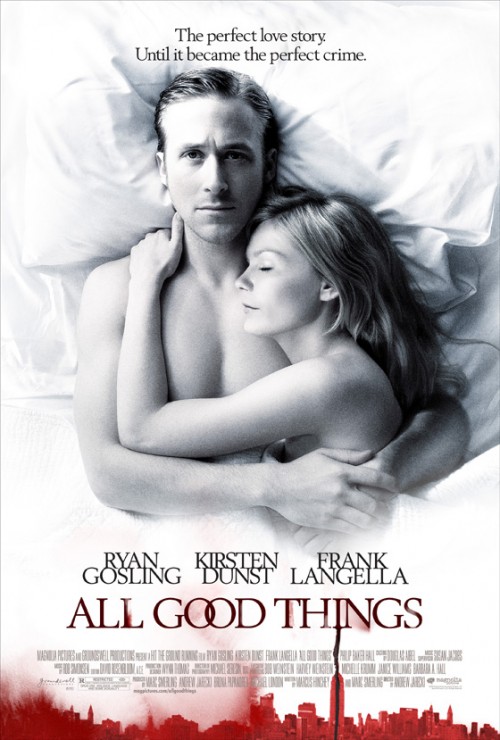
All Good Things not really a good thing
Posted in Movies, Reviews with tags , , , , , on December 8, 2010 by Sarah

Ryan Gosling’s latest, costarring Kirsten Dunst and Frank Langella, isn’t really good. It kills me to say that. I love Gosling. I love him so much not even his recent alleged dalliance with Blake F*cking Lively can kill my quiver for Gosling. You KNOW it hurts me to judge Gosling and find him less than. But there’s no getting around it. All Good Things isn’t good. And it wasn’t for lack of trying.

Dunst and Gosling both give acceptably good performances and Langella is as good as he always is as the emotionally distant father, Sanford, of David Marks (Gosling) a New York real estate heir who flounders through life. Sanford wants David to shape up and join the family real estate empire but David would rather move to Vermont with his pretty young wife, Katie (Dunst), and run a health food store. Langella does a great job combining Sanford’s seemingly real liking of Katie while simultaneously belittling her as “not one of them”—i.e., wealthy like the Marks family. Dunst plays Katie as a free spirit but it feels kind of flat, like Dunst is just treading water. It gets a bit better as Katie sinks into emotional despair as her marriage to David falls apart, but it’s still a remote, inaccessible performance. We just never care much about Katie, even though we know she’s struggling and we should have sympathy for her. Those actual emotions never actualize, though.

Gosling has “handsome but creepy loser” down pat but his work as David isn’t as exciting and engaging like he was in Lars and the Real Girl. He gives David a disconcerting habit of blinking too hard behind his glasses, but despite the entire story setup screaming, “David is disturbed and will do terrible things!” he just comes across as mopey and irresolute. When David does burst into violent rage, it is so far out of the character Gosling has established that it feels false. Dunst and Gosling don’t generate much chemistry (why exactly David and Katie fall in love is mysterious), but they work nicely together as scene partners and the devolution of David and Katie’s relationship injects some badly needed tension between them.

The acting, though not the best work any of them have done, is not the problem. The acting is actually the only thing that made All Good Things watchable. The central problems lie at the door of director Andrew Jarecki (the award-winning documentarian behind Capturing the Friedmans) and the script by Marcus Hinchey and Marc Smerling (both first-time feature film writers). The scripting problems mostly derive from the filmmakers’ attempt to “solve” the Robert Durst case—a real life missing persons and murder story that is so weird it’s like a gift made just for Chris Hansen.

In the 1970’s New York real estate heir Durst married Kathleen McCormack who disappeared in 1982. She was never found and the case remains unsolved; Durst was questioned but never charged. In 2000 Durst’s college friend, Susan Berman, was murdered in California. Again, Durst was questioned but not charged. Berman was murdered within days of being approached by a New York DA who wanted to talk about McCormack’s disappearance, but a connection between that and Berman’s death was never made. Also, Jarecki and his team totally ignore that the real Berman was a mafia princess who openly discussed her suspicions about her mother’s death and who wrote about life in the mob. Then in 2003 Durst was again implicated in a death—he went on trial for the murder of his neighbor, Morris Black. Durst was acquitted on grounds of self defense.

Robert Durst’s story is fascinating, the unsolved disappearance of his wife is intriguing—I grant you all of that. It’s easy to see why Jarecki was hooked. But then he goes on to try and solve all of this and in so doing he renders the characters uninteresting. It’s too clinical and procedural—Jarecki may as well have just made a documentary. And his direction doesn’t help with too many static scenes and a paint-by-numbers approach to staging and framing. The overall darkness of the lighting and tones of the production design combine with an overwrought score to give everything a melodramatic pall that kills any energy the actors are generating.

This movie isn’t terrible. It’s just forgettable.

Follow

Get every new post delivered to your Inbox.

Join 188 other followers